
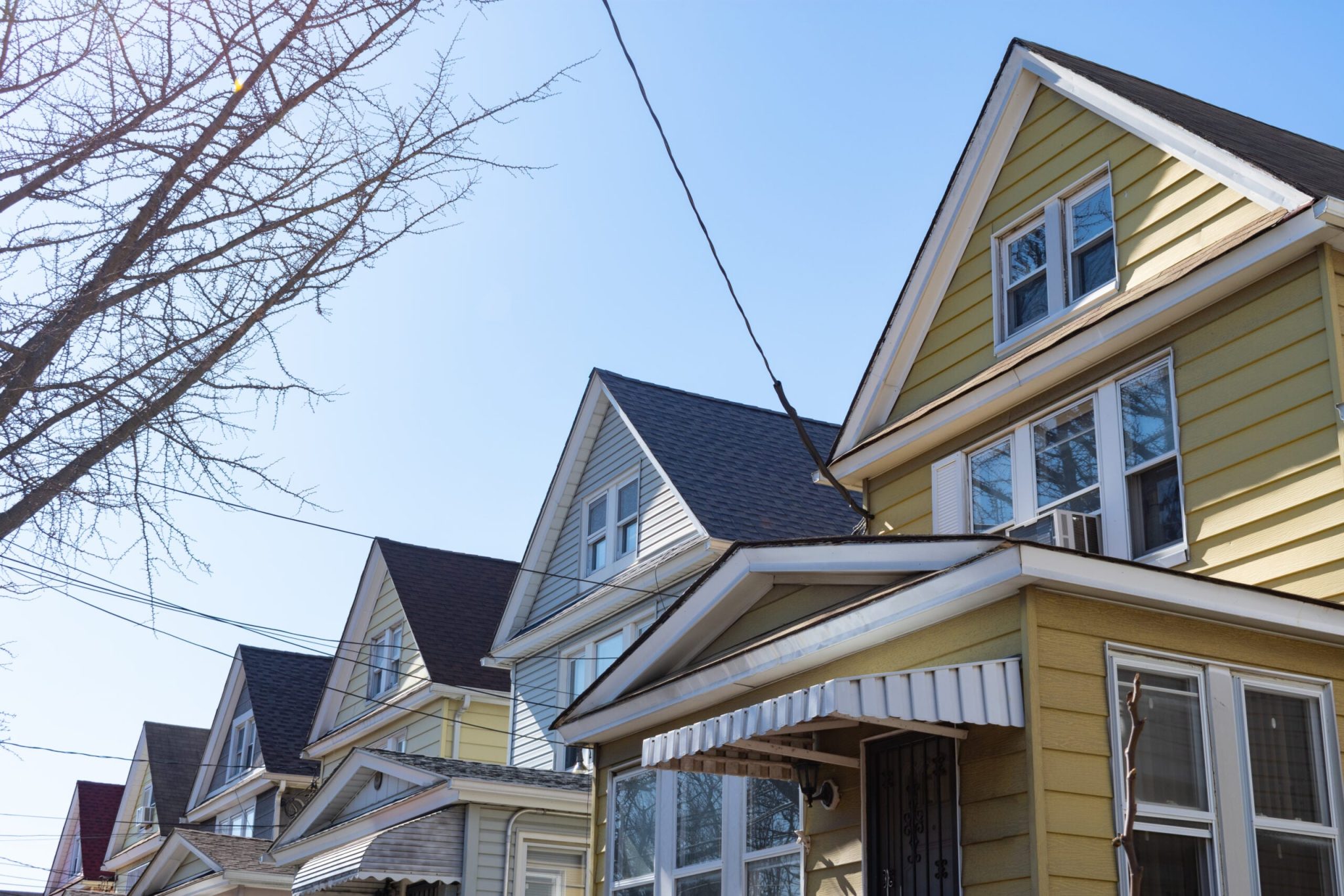

When Delores Kennedy-Williams moved to Indianapolis 53 years ago with her late husband, she was well aware of the city’s redlining past. Despite the challenges, the couple put down roots and bought a home in 1990. What she didn’t know then was how enduring that system would prove to be.
Over the ensuing decades, the now 88-year-old Black woman has witnessed the lasting effects of redlining unfold in her neighborhood: a decrease in Black homeowners, unequal lending, ongoing disinvestment, gentrification and a rise in institutional investors buying homes and turning them into rentals.
“I’ve watched the community go down, come up, go down and come up. I’ve seen the neighborhood change right before my eyes.”
— Delores Kennedy-Williams
Indianapolis homeowner
What Kennedy-Williams has witnessed is more than a housing shift. It’s a story of financial freedom and stunted progress.
To understand this fully, we need to go back to the 1930s. During the Great Depression, the Home Owners’ Loan Corporation (HOLC) ranked 239 cities based on lending risk. The government agency labeled mostly white areas ”safe” and highlighted them in green. Black and minority communities were outlined in red and labeled “hazardous.” Redlining, as the practice was known, cut entire communities off from credit, investment and opportunity.
Today, well over 8 million people in the U.S. live in neighborhoods that were redlined 90 years ago, according to 2020 Census data. But it’s not just about who lives where. Redlining continues to shape who can achieve and sustain homeownership in America. Not only does it drive property values, access to capital and levels of neighborhood investment, it also determines who can build equity, create wealth and pass on opportunity — or inequity — across generations.
Redlining didn’t disappear; it evolved.
Lost equity growth
Home equity, or the stake you have in your home, is one of the biggest ways people build wealth.
But according to Redfin’s most recent analysis on redlining in 2020, typical homeowners in formerly redlined neighborhoods gained 53% less equity, or $212,023 less, than homeowners in greenlined areas between 1980 and 2017. That gap likely widened during the 142% national surge in home equity between 2020 and 2025, according to Bankrate’s Best and Worst States for Home Equity study. This dramatic equity gap creates an additional obstacle, beyond the general home affordability crisis in the U.S., for homeowners in redlined areas looking to use equity to buy their next home.
“These historical policies, even though they’re not legal anymore, they still have economic consequences that persist across time,” explains Daryl Fairweather, chief economist at Redfin.
The result is a housing market where Black and Hispanic households — already less likely to own homes — are also less able to extract wealth from the homes they do own. And because these households tend to have fewer liquid assets, home equity is even more critical.
“If Black families have a lower homeownership rate, they’re going to also have lower amounts of home equity,” Fairweather says. “The redlining policy depressed home values in these areas. If people can’t get loans to buy homes, that decreases demand for homes, the value of the homes and also investment in the neighborhoods in general. The homes in Black neighborhoods tend to be priced lower than homes in white neighborhoods. So that also reduces equity.”
Aside from the homes themselves, the gap in equity growth has deeper implications.
“Most people use equity in their homes to start their businesses, so you’ll have lower business ownership rates,” says Andre Perry, senior fellow at the Brookings Institution, a non-partisan research organization based in Washington, D.C. “They use the equity to send their kids to college. If you had equity, you would be less reliant on student loan debt. It’s the money people use to move to a better neighborhood. There is an economic cost to individual consumers as well as to communities. Then there is a social cost that comes along with it. When we deny people their true value, we’re denying them dignity.”
Difficulty getting a mortgage
The Fair Housing Act of 1968 made redlining illegal, but the old red lines still influence who can and can’t get a mortgage today.
The National Community Reinvestment Coalition (NCRC), a nonprofit organization focused on underserved communities, analyzed Home Mortgage Disclosure Act (HMDA) data from 1991 and 2021. Neighborhoods once marked “hazardous” on HOLC maps received 2.5 times fewer loans than areas once graded as “best.” The disparity remains even after accounting for vacancy, owner-occupancy rates and housing age.
“Formerly redlined communities had reduced mortgage investment for over a century,” says Bruce Mitchell, a principal researcher at the NCRC. “The impact was especially deep in redlined Black neighborhoods, where mortgage availability was further suppressed until the most recent decade.”
Even today, homeownership rates in formerly “hazardous” areas are still roughly half those in greenlined neighborhoods, according to the most recent data from the Federal Reserve Bank of St. Louis.
“Mortgage markets are backward-looking, relying on historical sales to determine present values,” says Jason Richardson, senior director of research at the NCRC.
The lack of lending in one year depresses values, which makes lending more difficult the next. That is how lending discrimination became self-reinforcing.
— Jason Richardson
Senior director of research, NCRC
Kennedy-Williams notes that in her experience, lending discrimination in Indianapolis has not been a color or race issue, but what she calls segregation of economics.
“People who are just everyday workers, if they’re blue-collar workers, I don’t care how good their credit rating is; it’s going to be more difficult for them to get money loans from banks than it will be for those people who are professionals,” she says. “Even if they manage to save and get a lot of money, it would be very hard for them to get a loan from the bank. And I think that’s still true today.”
A big part of that is perception. While lenders may view white-collar, salaried employees as less risky in mortgage applications, blue-collar and hourly workers may be viewed as less predictable, even if the borrower is financially responsible.
…But what about credit scores?
A big challenge in mortgage disparities research is that detailed credit score data isn’t publicly accessible, says Mitchell. This makes it difficult to see the full picture of lending discrimination. While it’s true that Black and Hispanic borrowers tend to have lower credit scores and incomes on average compared to white borrowers, research suggests those differences don’t fully account for mortgage denial rates.
Even outside the context of redlining, 2024 research from the Federal Reserve Bank of Minneapolis found that applicants of color are more likely to be denied a mortgage. The disparity occurred even when their financial profiles (income, credit score and loan details) closely matched those of white applicants.
Lenders today are not literally following redlining maps, but the problem is far from gone. Modern technology, like artificial intelligence, can still reproduce historical inequities in what is known as digital redlining. Lenders use these automated systems to decide if someone is a good credit risk by pulling factors like credit history and even zip codes. As Korin Munsterman, a professor at the University of North Texas (UNT) Dallas College of Law, explains, even if the goal is to make things fair, past inequality can still shape present-day decisions.
“A predictive analytical tool, like determining whether somebody is a good credit risk, will look for patterns in the data,” she says. “But you can’t do it with technology if the technology can only learn from historical data. One major problem is that if the historical data does not include Black people getting mortgages and paying on time because they were never allowed into the market, then it’s not going to see that pattern.”
Navigating AI in lending decisions
While you can’t control the system, you can control how your application looks. Focus on the basics to improve your profile, like maintaining a strong credit history, lowering debt, showing stable income and checking your credit reports for errors.
It also helps to shop around, since different lenders use different models, and to ask for a manual review if denied.
Lending and housing discrimination are illegal. If something feels off, like being denied without a clear reason, report it to your local fair housing organization.
Low property valuations
Federal Reserve of St. Louis data continues to show a persistent gap in home values in historically redlined vs. greenlined neighborhoods, even decades after redlining was made illegal.
“No one’s saying that there are red lines in these areas, but these areas are less desirable, and ultimately those lower appraisals have an impact that reduces the amount of equity that a family and a community have to develop,” says Perry.
Although home prices have risen overall in both areas over the past few decades, formerly redlined areas’ values are half of those of traditionally greenlined areas.
“It’s not like once redlining was called out and made illegal, the property values just magically rose,” says Brian K. Seymour II, founder and CEO of Prosperitage Wealth, a financial planning firm based in Georgia. “You have the areas that were redlined previously still having depressed values.”
The low valuation generally has a lot to do with the older housing stock in redlined communities that was not considered valuable enough to rebuild or upgrade. This cycle, Mitchell says, is hard to break. “It means that year over year, unless there is a specific case where a neighborhood suddenly becomes very attractive to investment, they continue to lag behind.”
Opportunity to be had
Homes in historically redlined neighborhoods may have lower values; that doesn’t necessarily mean they’re bad options for you or your family.
Lower prices can be an opportunity, but whatever home you’re buying, make sure it aligns with your needs.
Consider trends like new development, infrastructure projects and job growth, as some areas may have strong potential for appreciation over time.
Prime areas for redevelopment and gentrification
Decades of disinvestment didn’t just hold these neighborhoods back; it reshaped them, leaving many communities overlooked and under-resourced.
“These are areas that are oftentimes devalued,” says Mitchell. “They might be areas that have higher levels of abandonment and vacancies within them.”
That long-term devaluation sets the stage for what comes next. Because home prices in these areas have been lower for so long, they often attract developers. This makes them prime areas for redevelopment and, in some cases, gentrification.
“Lower values can be attractive in an area that’s economically dynamic or a city that’s undergoing a dynamic of rapid population growth and has a dynamic economy,” says Mitchell. “In other cities that don’t have that kind of dynamic going on, they can continue to be areas of abandonment, vacancy and distress.”
What was overlooked, now has become an opportunity. On the surface, new buildings, stores, renovated homes, improvements in services and new businesses can breathe new life into neighborhoods and boost housing values. This looks like progress. But gentrification often serves as a bitter pill: Communities that were once excluded from investment are now at risk of being excluded from the benefits.
“People living there are faced, oftentimes, with an unaffordable situation, and they end up having to leave that neighborhood and go to another area that’s more affordable to them,” says Mitchell. “It makes it practically inaccessible to those who have lower incomes. Unfortunately, in a country like the United States, we have a high correlation of majority-minority areas that tend to lean lower-income.”
Source: Mapping Inequality: Redlining in New Deal America
Like Chicago, Detroit and New York, Indianapolis is among the 239 redlined cities marked on 1930s HOLC maps that are now seeing the effects of gentrification.
When Kennedy-Williams moved to Indianapolis in 1973, she remembers her Butler-Tarkington neighborhood as a thriving community overflowing with local businesses. But by the 1980s, the area began to decline, with stores closing and home vacancies increasing.
“So many of those houses are gone, torn down or rebuilt, and a lot of the new homes are being bought or developed by people from out of state,” she says. “Gentrification has taken over, and every spot has been built on. People have gotten old like me and can’t afford to stay in their homes, so they end up selling them.”
Gentrification is increasingly tied to institutional investors buying up homes in historically undervalued, low-income, majority-minority neighborhoods, some of which have been shaped by redlining.
“These are the neighborhoods that suffered coming out of the foreclosure crisis,” says Amy Nelson, executive director of the Fair Housing Center of Central Indiana. “We are now dealing with something new, and it isn’t just the lack of bank branches and mortgage opportunities. It’s also the role of institutional investors coming in and buying up the homes there and flipping them to expensive rentals. That takes away a formerly owner-occupied home from being an opportunity for a home buyer in these neighborhoods. It isn’t just the traditional, modern-day forms of redlining that we’re still battling.”
Top-ranked metros for gentrification intensity (1970-2010)
Gentrified urban neighborhoods increased by over 635% from the 1970s to the 2010s, according to the NCRC. Historically redlined neighborhoods are prime areas for modern gentrification. In fact, census data from 2010 and 2020 show that historically redlined cities like Denver, Atlanta and Miami have ranked among the top gentrifying neighborhoods for two decades or more.
Efforts to break the cycle
There have been efforts to fix the damage redlining left behind, but progress has been uneven.
The Community Reinvestment Act (CRA) of 1977 requires financial institutions to make banking services available to people in underserved areas. Unfortunately, not only is the CRA not always enforced as strongly as it could be, but the legislation hasn’t evolved with the times.
“A majority of mortgage lending today is not made by banks anymore. It’s made by mortgage companies,” says Mitchell. “We see this shifting dynamic within the industry. Banks are doing much lower levels of lending and mortgage companies, which don’t have the same CRA obligations; they are entering into those spaces and making more and more loans, but they don’t have the same responsibility under the law.”
Special Purpose Credit Programs (SPCPs) were designed to go a step further, with lenders giving extra support to people in historically disadvantaged communities with lower interest rates, reduced fees or more flexible loan requirements. However, in 2025, the Federal Housing Finance Agency moved to end Fannie Mae and Freddie Mac’s participation in SPCPs. Instead of being something that can scale across the country, they are likely to stay limited to individual lenders and small, local programs.
Downpayment assistance and first-time homebuyer grants can also help people get access to homeownership, especially in historically redlined areas. In some cities, they are putting money into affordable housing and anti-displacement efforts, trying to ensure longtime residents can benefit from new development instead of being pushed out as prices rise.
“Even though we don’t have redlining anymore, we still have single-family neighborhoods and multi-family neighborhoods, and that is its own type of segregation,” says Fairweather. “Eliminating the distinction and allowing all types of housing to be built in all neighborhoods can help accelerate desegregation and also bring about more equal outcomes.”
The red lines may officially be gone, but without legislation and lending and zoning reform, the same patterns risk repeating in new forms. Can future generations build wealth and stability without having to outrun the systems that once excluded them? Kennedy-Williams has hope.
“I have five children, four of whom live here [in Indianapolis],” she says. “Two of the four own their own homes, both inside the redlines but in nice neighborhoods. Hopefully, they can pass those homes on to their children, and we don’t have to leave our neighborhoods to have a nice environment. That’s my hope, that we don’t have to keep chasing the dream; that we will get it right where we are.”
Why we ask for feedback
Your feedback helps us improve our content and services. It takes less than a minute to
complete.
Your responses are anonymous and will only be used for improving our website.
Help us improve our content
Read the full article here